Debrief
Turn a session into something you can actually understand while it is still fresh, whether you are reviewing alone, with others, or with a coach.
A simple debrief flow
- Open the session
Load the track on a tablet or laptop while it is still fresh.
- Pick 1–2 moments
Choose the clearest examples — starts, mark roundings, manoeuvres, or a key decision.
- Replay and compare
Use the timeline to replay and compare boats from the same session. Look at differences in line, timing, and decisions.
- Agree one takeaway
Keep it calm: agree what happened, then choose one change to try next session.
What you see in the debrief
Playback
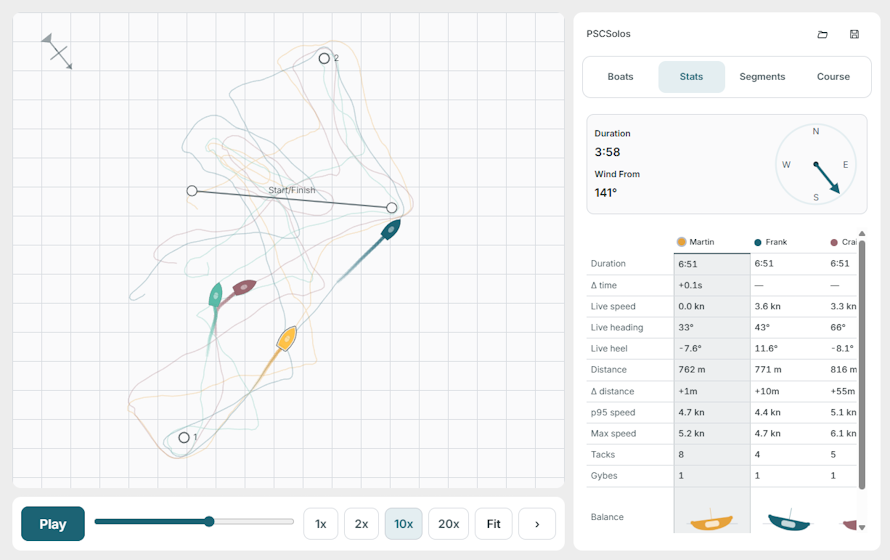
- All boats on a shared map with synchronised playback
- Adjustable playback speed and timeline scrubber
- Configurable trail length behind each boat
- Optional OpenTopoMap background
- Live per-boat speed, heading, and heel overlay
Session features
- Voice notes recorded on the water, transcribed and attached to the session
- Nearby boats discovered automatically from overlapping cloud tracks
- Session shared via link, WhatsApp, email, or native share
- Drawing and annotation tools within the debrief screen
Import and compatibility
- Native DTRK tracks from the Android app
- GPX files from any device
- CSV from Vakaros and generic column formats
- No installation on the debrief device — runs in any modern browser
Stats and analysis
- P95 speed, max speed, and distance per boat
- Tack and gybe detection with average, best, and worst loss in metres
- Live boat overlay: speed, VMG, heading, and smoothed heel at the current playback time
- Course analytics: per-leg elapsed time, distance, average speed, CMG, and fleet-best comparison
- Mark rounding analysis: tactical loss, clearance, and actual vs expected distance
- Portsmouth Yardstick handicap scaling for cross-class comparison
- Named segments for isolating specific parts of the session
Common questions
-
Do we need every boat to record?
No. One or two boats can still be useful. It becomes more valuable as more boats take part because comparison drives discussion.
-
How do we keep the debrief calm?
Pick 1–2 moments to focus on, and agree one takeaway for the next session.
-
What makes comparisons useful?
“Same session, same conditions” comparisons are the most repeatable. Look for patterns rather than single spikes.
-
What should we review first?
Start with the clearest objective moment: a start, a rounding, a manoeuvre, or a key decision point.
Next steps
Want to see what a real debrief looks like? Open one of the example sessions below.
Questions about running it at your club or training centre? Contact us at hello@dinghy.coach.